
Have you recently experienced shoulder pain after a fall or while playing a sport? That sudden sting or dull ache you sometimes feel in your shoulder? Maybe it shows up while lifting weights at the gym, reaching for something on a high shelf, or after a quick game of badminton or cricket. At first, it feels like no big deal that something will go away after some rest or a good sleep.
But then, a few days pass… and the pain is still there.You stretch, twist, massage it, maybe even try a home remedy, yet the discomfort doesn’t leave. And you start wondering: Why is my shoulder hurting so much? Was it that fall you didn’t think twice about? Or the heavy bag you always carry on one shoulder?
The shoulder is actually one of the most complex and flexible joints in the body. Whether you’re throwing a ball, swinging a racket, lifting weights, or even just reaching for a cup, your shoulder is constantly working. Because it moves so much, it’s also more likely to get injured, especially during sports or after a fall.
This is why shoulder pain shouldn’t be ignored. A small strain today can turn into a bigger problem tomorrow, affecting daily tasks like wearing clothes, combing your hair, or even sleeping comfortably.
Before we talk about the most common shoulder injuries from falls or during sports, let’s first understand how the shoulder works and why it’s so easy to injure.
Knowing this will help you spot problems early and take action before the pain gets worse or affects your long-term health.
Understanding the Shoulder Anatomy
Your shoulder is one of the most mobile joints in your body and that’s exactly why it’s also one of the most vulnerable. To understand why shoulder injuries happen, it helps to know what’s going on beneath the skin.
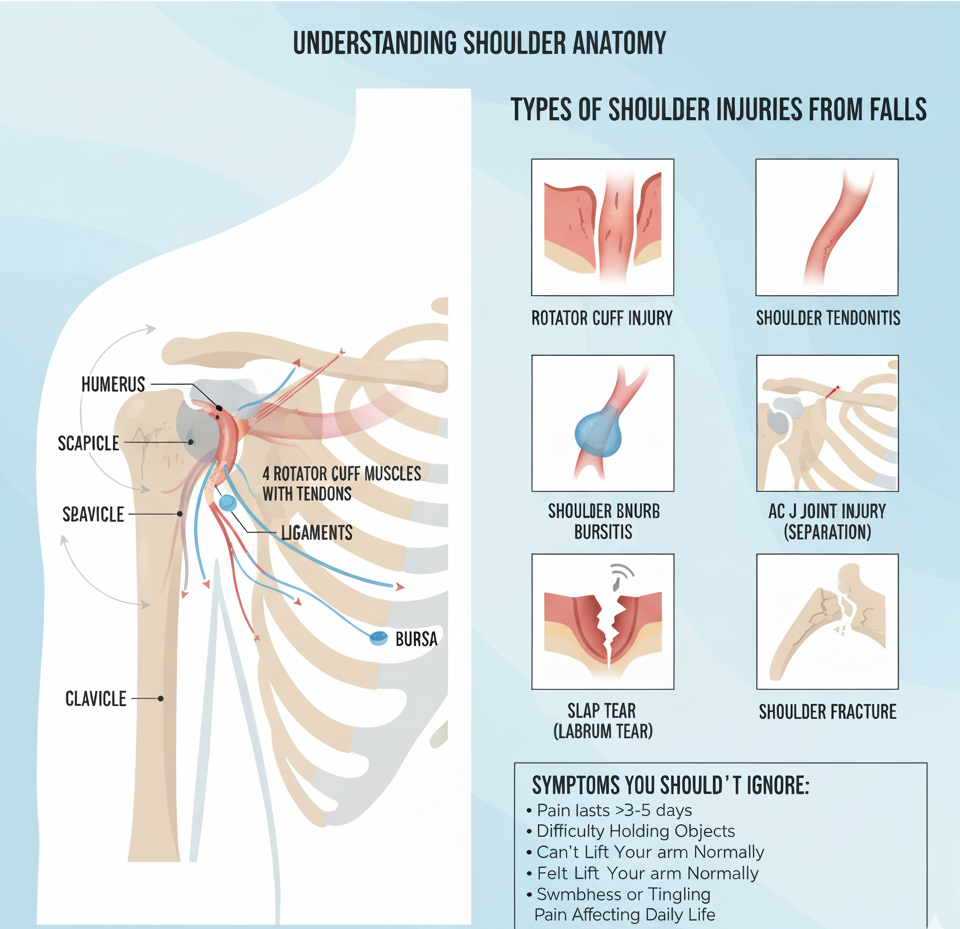
The shoulder is made up of three main bones:
Humerus – the upper arm bone
Scapula – your shoulder blade
Clavicle – your collarbone
These bones come together to form a ball-and-socket joint. The top of your arm bone (the “ball”) fits into a shallow socket in your shoulder blade. This structure lets your shoulder move in many directions: up, down, forward, backward, and even in circles, more than any other joint in your body.
But because the socket is shallow, your shoulder needs extra support to stay stable. That support comes from:
Rotator Cuff Muscles: A group of four muscles and their tendons that keep the “ball” centered in the socket every time you move your arm.
Ligaments: Tough, flexible tissues that connect bones and help keep the joint from moving too far.
Bursa: Small fluid-filled sacs that act like cushions to reduce friction when the shoulder moves.
So when you lift a weight, throw a cricket ball, swing a racket, or even reach overhead, all these parts work together. If even one of them gets strained, irritated, or injured, you can start to feel pain, weakness, or stiffness.
Why Shoulder Injuries Happen After Falling
There are several ways you can hurt your shoulder, not just during sports but even from everyday accidents.
Some of the most common causes include:
- Falling on an outstretched arm (trying to break a fall)
- Landing directly on the shoulder or upper arm
- Twisting or jerking the shoulder joint suddenly
- Overuse or repetitive motion (common in tennis, swimming, or weightlifting)
- Previous shoulder instability or weak rotator cuff muscles
When these things happen, your shoulder can suffer anything from mild inflammation to serious tears or dislocations.
Let’s explore the different types of shoulder injuries from falling and what each one feels like.
Types of Shoulder Injuries From Falling
I see many patients who arrive with shoulder pain that started either after a fall, a sports activity, or sometimes even without a clear trigger. The shoulder is a highly flexible joint, but that flexibility also makes it prone to injuries.
Below are some of the most common shoulder injuries that occur during sports or from falling on the shoulder. Understanding them will help you identify symptoms early and seek timely care.
1. Rotator Cuff Injury
The rotator cuff is a group of four muscles that help you lift and rotate your arm. In sports that involve overhead movement like badminton, tennis, cricket, bowling, swimming, or weightlifting, these muscles can become strained or, in severe cases, torn.
What you may feel:
- Pain while lifting the arm above shoulder height
- Weakness when reaching or rotating the arm
- Discomfort that worsens at night
If ignored, a simple strain can progress to a more serious tear. While mild tears can heal with injection therapies for shoulder pain, severe cases may require guided physical rehabilitation.
2. Shoulder Tendonitis
This occurs when the shoulder tendons become irritated due to repeated use. Many people try to “push through” this discomfort during training, which unfortunately can worsen the inflammation.
Common sign: A dull, aching pain that slowly increases over days or weeks, especially when using the arm overhead.
3. Shoulder Bursitis
The shoulder contains small cushions called bursae that help reduce friction. These can become inflamed after repetitive motion or a direct fall on the shoulder.
You may notice:
- Pain when raising the arm
- A sense of tightness or stiffness
- Discomfort even during simple daily activities like reaching for clothes
4. Shoulder Dislocation
A forceful impact, such as falling directly on the shoulder, can cause the ball of the upper arm to shift out of its socket. This is a painful injury and requires prompt medical attention.
Symptoms include:
- Severe pain
- Inability to move the arm
- A visible change in shoulder shape
If you’ve experienced a dislocation, explore pain management treatments that aid post-injury recovery.
5. AC Joint Injury (Shoulder Separation)
The acromioclavicular (AC) joint, located at the top of the shoulder, can be injured during contact sports or falls.
Typical signs:
- Pain at the top of the shoulder
- Tenderness when touching the area
- Pain increases when lifting or carrying bags
6. SLAP Tear (Labrum Tear)
The labrum is a ring of cartilage that stabilizes the shoulder joint. Sudden falls or repetitive throwing motions can injure it.
This is commonly seen in:
- Cricket bowlers
- Volleyball and tennis players
- Weightlifters
Patients often describe a “deep” shoulder pain and sometimes a clicking sensation.
7. Shoulder Fracture
A significant impact, such as a road accident or a heavy fall, may lead to fractures in the collarbone or upper arm bone.
Symptoms:
- Sharp, intense pain
- Swelling and bruising
- Inability to move the shoulder normally
This requires immediate medical diagnosis.
What Happens When You Fall on Your Shoulder?
When you fall on your shoulder, three things can happen depending on the direction of impact and whether you landed on an outstretched arm or directly on the joint. Landing on an outstretched hand or arm, the most common instinct to break a fall, transmits force up through the wrist and elbow to the shoulder, most commonly damaging the rotator cuff or labrum. Landing directly on the point of the shoulder, common in trips and sideways falls, compresses the AC joint (the joint at the top of the shoulder where the collarbone meets the shoulder blade), often causing separation or bursitis. A high-impact fall from a height, a car accident, or a heavy collision can cause dislocation or fracture, alongside soft tissue damage.
The shoulder absorbs fall impact differently from the hip or knee because it is a shallow ball-and-socket joint held in place by soft tissue rather than deep bony architecture. This makes it highly mobile but also means that the muscles, tendons, and ligaments bear the full force of an impact rather than the bones distributing it.
Why Your Shoulder Hurts When You Try to Raise Your Arm After a Fall
Difficulty raising the arm after falling on your shoulder is one of the most specific and important symptoms to pay attention to. It almost always indicates one of three things: a rotator cuff tear (the muscles that lift the arm are damaged), a shoulder dislocation (the ball is partially or fully out of the socket and the joint mechanics are disrupted), or an AC joint separation (the collarbone has separated from the shoulder blade, causing pain and mechanical restriction at the top of the shoulder). All three require specialist evaluation; none resolves reliably with rest alone.
What Injuries Can Happen When You Fall on Your Shoulder?
Some of the most common shoulder injuries from falls include:
- Dislocations
- AC joint separation
- Labrum tears
- Bursitis or tendon irritation
- Collarbone or upper arm fractures
If pain persists for more than 48 hours after a fall, it is better to get it assessed rather than assume it will resolve on its own.
Why These Injuries Happen
The shoulder is designed for movement, not heavy impact.
Because the joint is shallow, it depends heavily on muscles, tendons, and ligaments for stability. When one of these structures gets overloaded or injured, pain and limited movement follow.
Symptoms You Shouldn’t Ignore
If you’ve recently fallen or injured your shoulder, don’t wait for pain to “just go away.” Seek medical attention if you notice:
Please do not ignore these signs:
- Pain that lasts longer than 3–5 days or keeps returning
- Sharp pain when lifting the arm or reaching overhead
- Weakness in the shoulder or difficulty holding objects
- Clicking, popping, or a catching feeling during movement
- Swelling, warmth, or visible bruising around the shoulder
- Pain that worsens at night or wakes you up from sleep
- Difficulty performing everyday tasks like wearing clothes or combing hair
Persistent pain is your body’s way of saying something that needs attention. Treating the shoulder early prevents the injury from becoming more serious.
When to Seek Medical Help
You should consult a doctor or shoulder specialist if:
- Pain stays for more than a week despite rest or home remedies
- You fell on your shoulder and felt immediate pain or instability
- You heard or felt a “pop” at the moment of injury
- There is a loss of movement, or you cannot lift your arm normally
- Your shoulder looks uneven or out of place (possible dislocation)
- You notice numbness or tingling in the arm or hand
- Pain interferes with sleep or daily activities
The earlier the diagnosis, the easier and faster the recovery. Waiting too long may lead to stiffness, chronic pain, or muscle weakness that takes longer to treat.
Conclusion
Shoulder pain may seem like a small inconvenience at first, something that will “get better with time.” But whether it started after a fall, a wrong lift at the gym, or a sports injury, it’s your body’s way of saying something isn’t right.
Understanding the types of shoulder injuries from falling and how the shoulder works helps you take action early before the pain turns chronic or limits your movement. Simple steps like rest, posture correction, and strengthening can make a huge difference, but in some cases, professional help is the safest route.
If your pain doesn’t subside after a few days or you notice swelling, weakness, or stiffness, it’s time to consult a pain management specialist. Early diagnosis not only helps you recover faster but also prevents long-term joint damage.
Frequently Asked Questions About Shoulder Injuries From Falling
What happens if you fall on your shoulder?
When you fall on your shoulder, the impact can strain or damage the muscles, ligaments, or bones. Depending on how you land, this can lead to injuries such as sprains, dislocations, fractures, or rotator cuff tears. Some people feel immediate sharp pain, while others may notice stiffness or discomfort developing later.
Why does my shoulder hurt after a fall?
Shoulder pain after a fall usually happens because the tissues in your shoulder have been stressed or injured. This could be due to inflammation, muscle strain, ligament injury, or even a small fracture. Pain may worsen when you try to lift your arm, rotate your shoulder, or sleep on the affected side.
Can shoulder pain appear later after a fall?
Yes, it’s common for shoulder pain to appear hours or even days after a fall. This is often due to inflammation building up in the injured area. Conditions like soft tissue injuries or minor tears may not cause immediate symptoms but can become painful over time.
When should I worry about a shoulder injury after a fall?
You should seek medical attention if you experience severe pain, swelling, visible deformity, or if you cannot move your shoulder or lift your arm. Persistent pain that doesn’t improve within a few days may indicate a more serious injury that needs evaluation.
I fell on my shoulder and it hurts to move it. What should I do?
Start by resting your shoulder and avoiding movements that cause pain. Applying ice can help reduce swelling, and over-the-counter pain relief may help manage discomfort. However, if the pain is severe, limits your movement, or doesn’t improve within a few days, it’s important to consult a specialist.
Can a shoulder injury from a fall heal on its own?
Mild injuries like minor strains or sprains may heal with rest and basic care. However, more serious injuries such as fractures, dislocations, or tendon tears usually require medical treatment. Getting the right diagnosis early can help prevent long-term complications.