

You’re getting out of a chair, pushing your palm flat on the armrest. Suddenly—a sharp, unexpected zap of pain shoots through your wrist. Or maybe it’s a dull, deep ache when you finally put down that heavy grocery bag. The common thread? The pain only happens when you bend your wrist.
If this sounds familiar, understanding the cause is the first step, but getting the right treatment often requires guidance from a pain management specialist who can accurately diagnose and treat the root issue.
It’s a frustrating and often worrying question: Why does my wrist feel fine until I move it a certain way?As we covered in our comprehensive guide, Wrist Pain: Common Causes and Treatment Options, the “why” behind your pain depends heavily on location and sensation. This post takes a deeper dive into that specific, sharp pain that arrives with bending. We’ll break down the most likely culprits, what the sensation means, and—most importantly—when to seek expert help.
The Anatomy of a Bend: What Happens Inside Your Wrist?
Think of your wrist as a complex suspension bridge. The bones are the towers, the ligaments are the cables, and the tendons are the main traffic lanes that allow your fingers and hand to move. The median and ulnar nerves are the electrical lines running through the middle.
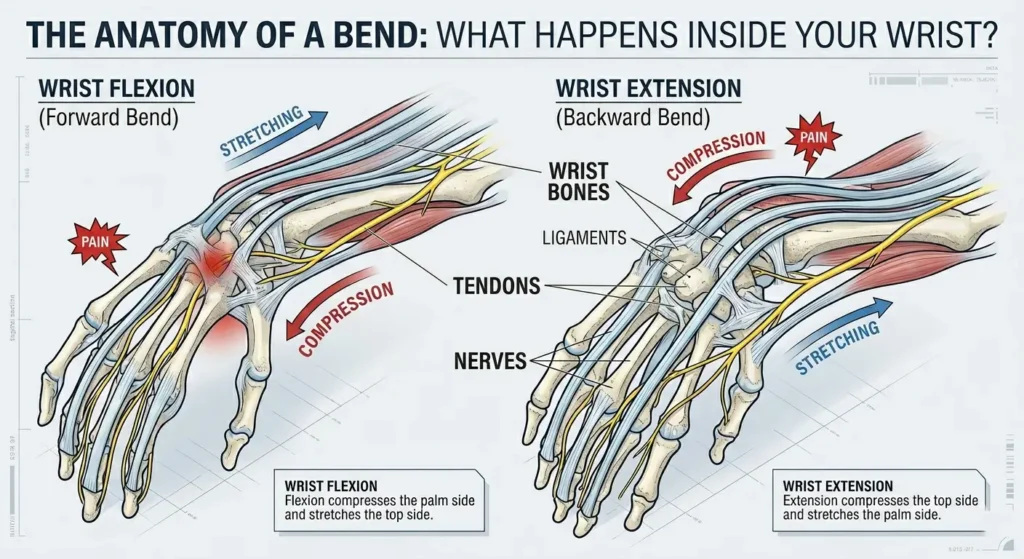
When you bend your wrist forward (flexion) or backward (extension), you are:
- Compressing one side of the joint.
- Stretching the tendons and nerves on the opposite side.
Pain with bending means this compression or stretching is irritating a specific, inflamed structure. The exact location of the pain tells you which structure is in trouble.
Pain When Bending the Wrist DOWN (Flexion)
Bending your wrist down, so your fingers point toward the floor, is called flexion. Pain here usually points to two main issues on the palm side of your wrist.
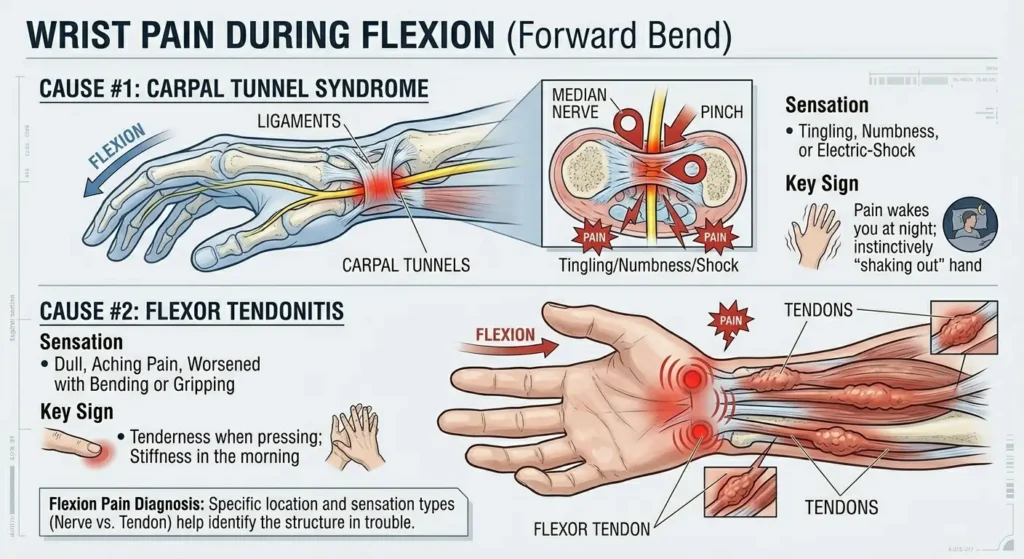
Cause #1: Carpal Tunnel Syndrome
This is a top contender. The carpal tunnel is a narrow passageway in your wrist. Bending your wrist reduces the space in this tunnel even further, compressing the median nerve.
- Sensation: Tingling, numbness, or an electric-shock feeling in your thumb, index, and middle fingers.
- Key Sign: The pain often wakes you up at night, and you instinctively “shake out” your hand for relief.
Cause #2: Flexor Tendonitis
These tendons run from your forearm muscles to your fingertips, allowing you to make a fist. Overuse (e.g., repetitive gripping, typing, or playing guitar) inflames them.
- Sensation: A dull, aching pain on the palm side of the wrist that gets worse with repeated bending or gripping.
- Key Sign: Tenderness when you press on the spot that hurts, and stiffness in the morning.
Pain When Bending the Wrist BACK (Extension)
Bending your hand back, like you’re about to do a push-up or stop traffic, is an extension. This is an extremely common source of bending-related pain, usually originating on the top of the wrist.
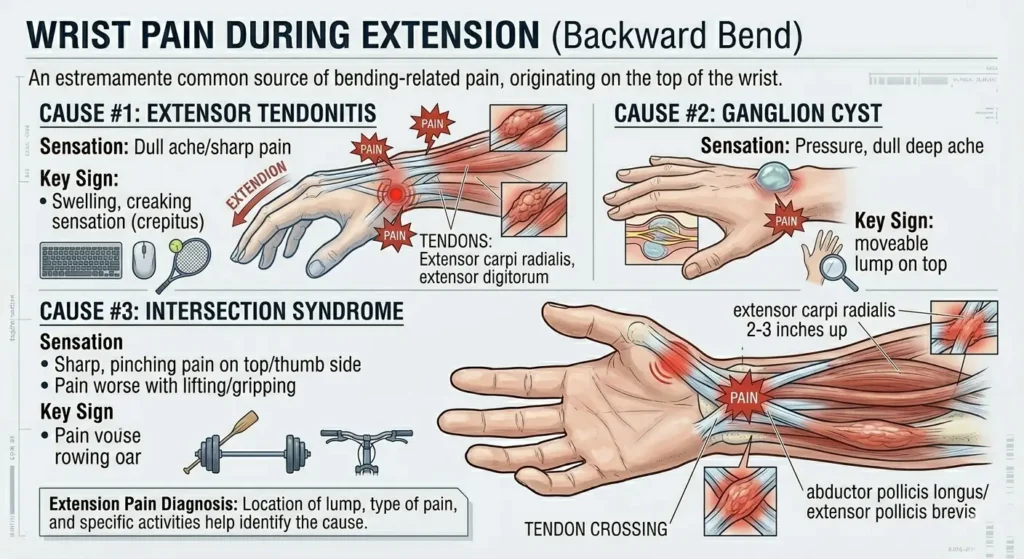
Cause #1: Extensor Tendonitis
These tendons run along the top of your wrist and straighten your fingers. Repetitive lifting, typing with poor form, using a computer mouse, or playing sports like tennis can all cause this overuse injury.
- Sensation: A dull ache or sharp pain on the top of the wrist when you bend the hand backward or make a fist.
- Key Sign: Swelling or a visible “creaking” sensation (crepitus) when you move the wrist.
Cause #2: Ganglion Cyst
This is a non-cancerous, fluid-filled sac that often forms on the top of the wrist, near the joint. It may be pea-sized or larger. When you bend your wrist back, the cyst gets pinched or stretches the surrounding tissue.
- Sensation: A feeling of pressure or a dull, deep ache that increases with backward bending.
- Key Sign: You may feel a small, firm, but moveable lump on the top of your wrist.
Cause #3: Intersection Syndrome
Think of this as “tendonitis behind the tendonitis”. It occurs where two wrist extensor tendons cross over each other, about 2-3 inches up from the wrist joint on the top/thumb side. It’s common in rowers, weightlifters, and cyclists.
- Sensation: A sharp, pinching pain on the top/thumb side of the wrist when bending it backward and outward (like making a hitchhiking thumb).
- Key Sign: Pain is often worse with lifting or gripping than with simple bending.
Wrist Pain When Bending – What It Could Mean
| Movement / Pain Type | Possible Cause |
| Pain when bending forward | Flexor tendonitis, carpal tunnel |
| Pain when bending back | Extensor tendonitis, ligament strain |
| Pain on top of wrist | Ganglion cyst, intersection syndrome |
| Sharp pain when bending | Ligament injury or nerve issue |
Decoding the Sensation: Sharp vs. Dull Pain
The type of pain is a powerful diagnostic clue.
- Sharp, Stabbing, or Shooting Pain: This often suggests an acute injury. Think a wrist sprain (torn ligament) or a small, non-displaced fracture (like a scaphoid fracture from a fall). If the pain came on suddenly during an activity, do not ignore it. This requires imaging (X-ray/MRI) to rule out a break.
- Dull, Aching, Throbbing Pain: This is the hallmark of chronic overuse. Tendonitis and early arthritis typically present this way. The pain may start mild, worsen with activity, and feel better with rest.
- Tingling or “Pins and Needles”: This is almost always nerve-related. Carpal tunnel syndrome is the prime suspect, but nerve compression elsewhere in the neck or elbow can also refer to symptoms in the wrist.
From Pain to Plan: Diagnosis and Next Steps
Self-diagnosis is risky because conditions overlap. A specialist will follow a process similar to what we outlined in our main wrist pain guide:
- Physical Exam: They will bend your wrist in specific ways (e.g., Phalen’s maneuver for carpal tunnel) to recreate the pain.
- Imaging: X-rays for bone issues, or an Ultrasound/MRI to visualize inflamed tendons, ligaments, or a ganglion cyst.
Home Care (For Mild, Recent-Onset Pain):
- Rest: Stop the activity that causes the bend-pain for 48 hours.
- Ice: Apply ice for 15 minutes, 3-4 times a day, especially for top-of-wrist pain.
- Brace: A wrist brace that limits bending (especially at night) can be a game-changer, particularly for suspected carpal tunnel or tendonitis.
- Ergonomics: Adjust your keyboard height so your wrist is straight, not bent back.
Important: If home remedies don’t bring clear improvement within 3-7 days, or if the pain returns immediately when you resume normal activity, it’s time to see a professional.
When Home Care Isn’t Enough – The Specialist’s Role
Ignoring consistent “bending pain” allows the underlying problem to become chronic. A pain management specialist offers targeted solutions that go beyond rest and ice.
For the specific causes of bending pain, medical treatments can be highly effective:
- Steroid Injections: A single, image-guided injection can powerfully reduce inflammation in a specific tendon (tendonitis) or shrink a painful ganglion cyst.
- Nerve Blocks: For confirmed carpal tunnel syndrome causing bending pain, a nerve block can provide immediate relief and break the cycle of inflammation and compression.
- Minimally Invasive Procedures: For chronic cases that don’t respond to injections, procedures like Tenex (for tendonitis) or ultrasound-guided nerve release (for carpal tunnel) offer lasting relief with little downtime.
Don’t Let a Simple Bend Hold You Back
Pain in your wrist when bending—whether forward, backward, sharp, or dull—is your body’s clear signal that a specific structure (a tendon, nerve, or joint) is overloaded or compressed. You don’t need to live with it, nor should you guess your way through a dozen home remedies.
If bending your wrist causes sharp pain, numbness, or discomfort that isn’t improving after a week of rest, it’s time to see a specialist. The expert team at Washington Pain and Spine can pinpoint the exact cause of your bending pain, from extensor tendonitis to carpal tunnel syndrome, and create a personalized plan to get you moving freely again.Don’t let wrist pain limit your life. Contact us today for an evaluation and get back to the activities you love.