

You did everything right, you had the surgery, followed instructions, and expected relief.
But now you’re dealing with back pain after surgery, and you’re wondering:
“Why is this happening again… or why is my back hurting when they didn’t even operate on my back?”
To understand what your body is trying to tell you, we need to look at two different paths patients fall into.
But first, here are two real situations we see every week:
Scenario 1:
You’re weeks out from a knee replacement, but now you’re constantly rubbing your lower back. You’re confused:
“My knee surgery went great… So why does my back hurt?”
Scenario 2:
Months after a discectomy, you start feeling the same old sciatica creeping back.
“Is my problem returning? Did my surgery fail?”
Both people feel lost and both deserve answers.
The truth is this:
Back pain after surgery depends on one key question,
Was your surgery on your spine, or was it somewhere else?
This article will map both paths, explain what causes pain in each situation, and guide you toward the right solutions.
Two Possible Paths: Which One Fits You?
To understand your symptoms clearly, we break post-surgical back pain into two major categories. Path A applies to people whose surgery was not on the spine, and Path B applies to those who had spine surgery but continue to experience returning or persistent pain
PATH A:
Your surgery was NOT on your spine → you have new back pain
(Examples: hip, knee, abdomen, chest, hysterectomy)PATH B:
Your surgery WAS on your spine → your old pain is back, or worse
(Examples: fusion, laminectomy, discectomy, microdiscectomy)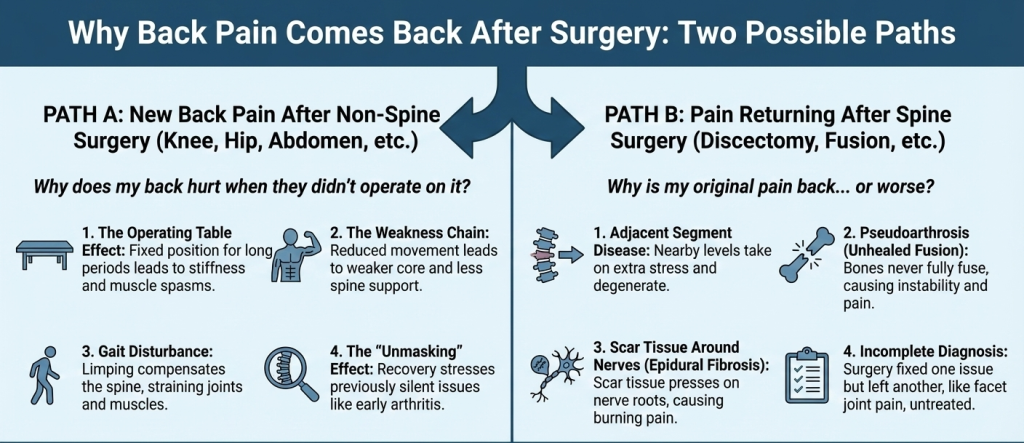
PATH A: New Back Pain After Non-Spine Surgery
“Why does my back hurt when they operate on my knee/hip/abdomen?”
Back pain after non-spine surgeries is extremely common and almost always has a logical explanation.
Here are the top reasons:
1. The Operating Table Effect
During long surgeries, your body is placed in a fixed position.
Pressure on the spine, ligaments, and muscles can lead to:
- lower back pain after surgery
- stiffness and muscle spasms
- sacroiliac (SI) joint irritation
2. The Weakness Chain
After any major surgery, your body naturally reduces movement.
This leads to:
- weaker core muscles
- tight hip flexors
- less support for the lower spine
Result: Your back has to overwork → back pain after surgery.
3. Gait Disturbance (Hip/Knee/Foot Surgeries)
When you limp even slightly your spine compensates.
This causes:
- strain on lumbar joints
- SI joint stress
- muscle imbalance
4. The “Unmasking” Effect
Sometimes surgery triggers a mild, previously silent issue like:
- early arthritis
- a small disc bulge
- old mechanical back pain
You weren’t aware of it before, but recovery stresses your system and brings it to the surface.
PATH B: Pain Returning After Spine Surgery
“Why is my original pain back… or worse?”
When back pain returns months after spinal surgery or never improves at all one possible explanation is a condition known as Failed Back Surgery Syndrome (FBSS). FBSS doesn’t mean anything ‘failed’ ; it simply describes persistent or recurring pain after spine surgery due to factors like nerve irritation, scar tissue, instability, or unresolved pain generators.
However, FBSS is only one possibility. There are several structural and mechanical reasons why back pain may return after surgery.
If you want a deeper explanation and treatment options, you can also refer to our full FBSS blog for more details
If you had spine surgery and now feel:
- back pain returning after surgery
- pain coming back after surgery
- back pain worse after surgery
- or pain that never improved at all
This may be due to one of the following:
1. Adjacent Segment Disease (Next-Door Problem)
After a fusion, nearby levels take on extra stress and may start to degenerate.
2. Pseudoarthrosis (Unhealed Fusion)
If the bones never fully fuse, tiny movements can cause:
- stabbing pain
- mechanical back pain
- ongoing instability
3. Scar Tissue Around Nerves (Epidural Fibrosis)
Scar tissue is normal…
but when it presses around a nerve root → pain returns.
Often felt as:
- burning
- sharp radiating pain
- recurring sciatica
4. Incomplete Diagnosis or a New Pain Generator
Sometimes surgery fixes one problem but leaves another untreated:
- facet joint pain
- SI joint pain
- recurrent disc herniation
This is a common cause of persistent back pain after surgery.
The Universal Problem: When Back Pain Becomes Chronic
Whether you fall under Path A or Path B, pain that lasts more than 6–12 weeks is no longer typical healing pain.
This stage often involves:
- nerve hypersensitivity
- chronic inflammation
- muscle guarding
- central sensitization (an overactive nervous system)
This explains why pain can feel:
- disproportionate
- widespread
- worse at night
- unresponsive to rest
- unpredictable
The good news?
This is treatable with the right approach.
STEP 1: See a Pain Management Specialist
Surgeons fix structure. Pain specialists decode pain sources.
A pain management specialist can diagnose whether your back pain after back surgery or another operation is:
- nerve-related
- joint-related
- muscular
- scar tissue-related
- compensatory gait pain
STEP 2: Precision Diagnosis
PATH A (For non-spine surgery)
Your evaluation may include:
- gait analysis
- SI joint testing
- facet joint evaluation
- diagnostic injections
PATH B (For spine surgery)
You may need:
- MRI or CT compared with pre-op images
- selective nerve blocks
- evaluation for instability or recurrent disc issues
These tests are far more accurate than guessing.
STEP 3: Your Modern Treatment Roadmap
Depending on your path, treatments may include:
1. Physical Therapy (specialized)
- core stabilization
- gait retraining
- mobility restoration
2. Interventional Pain Procedures
- Epidural steroid injections
- Nerve blocks
- SI joint injections
- Facet joint injections
- Radiofrequency ablation
3. Neuromodulation for Severe Nerve Pain
For FBSS-type symptoms or severe nerve pain:
- DRG stimulation
These are breakthrough treatments for back pain not improving after surgery.
Conclusion
If you see yourself in Path A or Path B, the most important step is to break the cycle of confusion and frustration. Back pain after surgery whether new or returning is a sign that your recovery needs a more precise plan.
At this stage, the goal isn’t simply “healing from surgery”. It’s about:
- identifying the exact structure generating your pain
- calming an over-sensitized nervous system
- restoring function through targeted strength and movement
You don’t have to accept pain as your new normal. Modern pain management after back surgery and comprehensive care from an experienced pain management center provide clear, effective pathways to relief, often without the need for repeat surgery.
Disclaimer: The information provided in this blog is for educational and informational purposes only and is not a substitute for professional medical advice, diagnosis, or treatment. Always seek the advice of your physician or qualified healthcare provider regarding any medical condition or treatment options.